AI vs Traditional Recruiting in Healthcare: What’s Changing
Jan 4, 2025
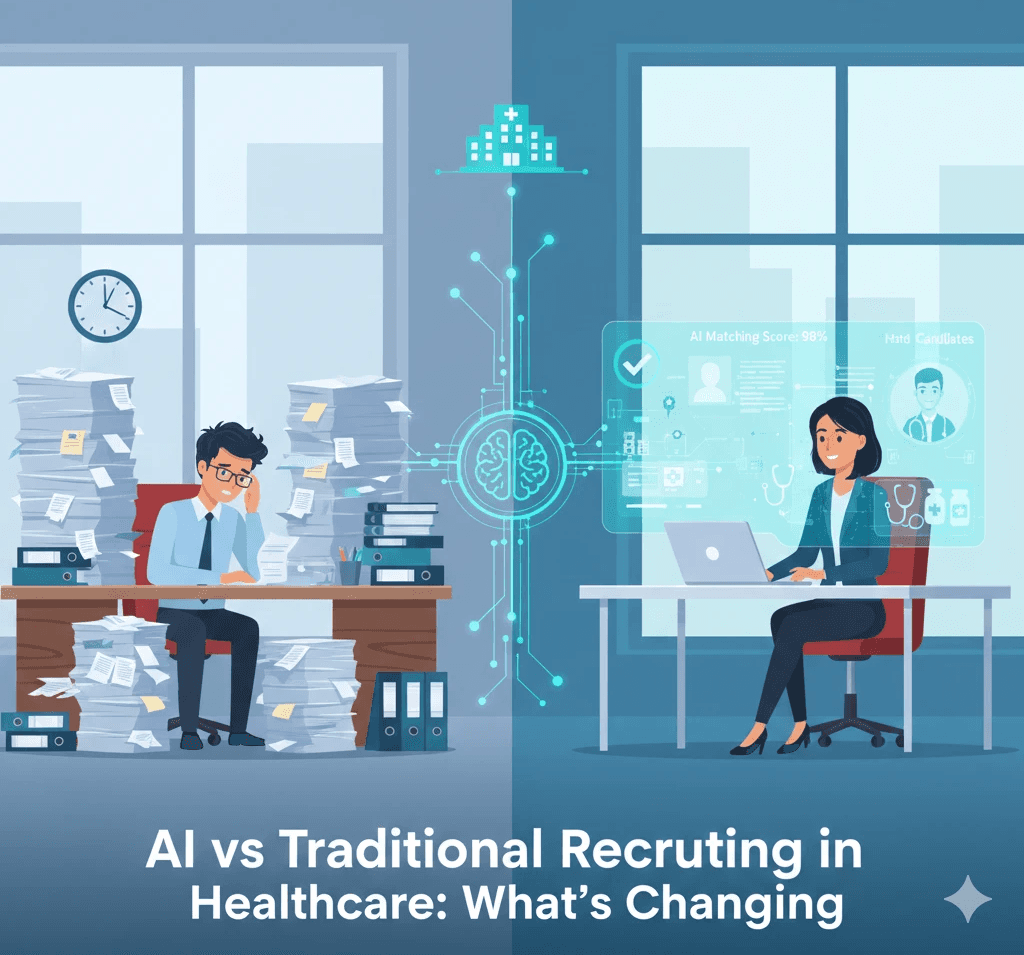
In the high-stakes world of healthcare recruiting, where talent shortages can delay patient care and inflate costs, the battle between AI-powered tools and traditional methods rages on. Traditional hiring—think manual resume sifting, phone screens, and gut-feel interviews—has long dominated. But AI is reshaping the field, promising speed, precision, and scalability. As healthcare faces a projected global shortage of 10 million workers by 2030 (World Health Organization), recruiters need to know: Is AI a game-changer or just hype? Let's break it down.
The Traditional Recruiting Playbook: Reliable but Resource-Heavy
Traditional recruiting in healthcare relies on human intuition and time-tested processes. Recruiters post jobs on platforms like LinkedIn or Indeed, comb through hundreds of CVs, conduct initial calls, and advance candidates through multi-round interviews. Reference checks and background verifications follow, often manually via emails or phone calls.
This approach shines in nuance. A seasoned recruiter spots soft skills—like a nurse's empathy during a behavioral interview—that algorithms might miss. In healthcare, where bedside manner matters as much as credentials, this human touch builds trust. A 2023 SHRM study found 68% of healthcare hires succeed long-term due to cultural fit assessed manually.
Yet, drawbacks abound. Time-to-hire averages 42 days in healthcare (LinkedIn's 2025 Global Talent Trends), delaying critical fills for roles like ICU specialists. Costs soar too: U.S. hospitals spend $4,000–$7,000 per nurse hire (NSI Nursing Solutions). Manual background checks, vital for compliance with HIPAA and credentialing, drag on for weeks, risking compliance gaps amid rising fraud cases (up 15% in 2024 per FTC data).
Enter AI: Automation Meets Intelligence
AI flips the script by automating the grunt work. Tools like applicant tracking systems (ATS) with natural language processing (NLP) scan resumes in seconds, ranking candidates by skills match—say, matching a physician's EHR proficiency to job needs. Predictive analytics forecast candidate success using historical data, reducing bias through anonymized screening.
In healthcare, AI excels at volume. Gigin.ai's platform, for instance, uses AI to parse thousands of profiles instantly, flagging verified nurses with exact certifications. Chatbots handle initial screens, asking scenario-based questions like "How would you handle a combative patient?" Machine learning refines matches over time, improving accuracy by 30–40% (Gartner 2025 HR Tech Report).
Background verification? AI streamlines it. Automated checks cross-reference databases for licenses, criminal records, and employment history in hours, not days—crucial for healthcare's zero-tolerance compliance. A McKinsey analysis shows AI cuts verification time by 70%, slashing costs and enabling faster onboarding.
Real-world wins: Cleveland Clinic reduced nurse hiring time by 25% with AI screening (2024 case study). Predictive tools now flag flight risks, with one U.S. health system retaining 15% more staff post-implementation.
Head-to-Head: Where AI Wins and Humans Still Rule
Aspect | Traditional Recruiting | AI-Driven Recruiting |
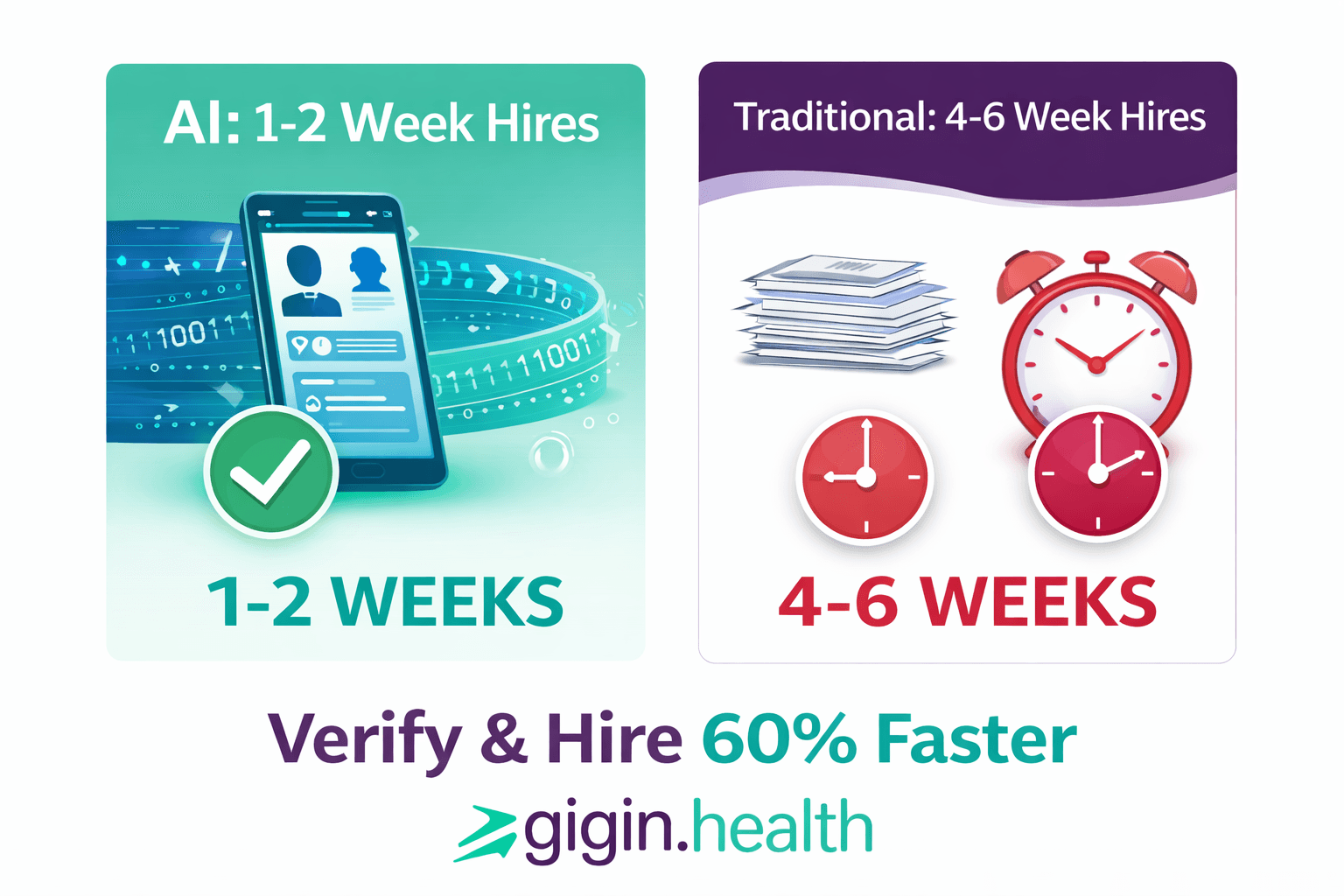
Speed | 4–6 weeks per hire | 1–2 weeks, 50–70% faster |
Cost | $5K+ per mid-level hire | 30–50% reduction via automation |
Volume Handling | Struggles with 100+ apps | Scales to thousands effortlessly |
Bias Reduction | Prone to unconscious bias (e.g., names) | Algorithms trained on diverse data |
Accuracy | High on soft skills | 85–95% on skills/credentials (Forbes) |
Compliance | Manual, error-prone | Automated audits, audit trails |
AI dominates scalability and efficiency, especially for high-volume roles like CNAs or telehealth docs. It democratizes access, sourcing passive talent from global pools—vital as 40% of healthcare pros are gig workers (Upwork 2025). Traditional methods, however, retain an edge in empathy-driven assessments, like evaluating a surgeon's teamwork via panel interviews.
The hybrid sweet spot? Use AI for triage and verification, humans for finals. This "centaur" model boosts outcomes: Deloitte reports 22% better hires with AI-human combos.
Challenges and the Road Ahead
AI isn't flawless. Data privacy worries loom—healthcare's sensitive info demands GDPR/HIPAA compliance. "Black box" algorithms can perpetuate biases if not trained properly, and over-reliance risks missing red flags like burnout signals. Adoption lags too: Only 35% of healthcare HR teams use AI fully (Deloitte 2025).
Yet, momentum builds. By 2027, 75% of hires will involve AI (IDC forecast). In the USA, where hospitals battle 20% vacancy rates (NHFW 2025), platforms like Gigin.ai lead with seamless AI verification for gig clinicians.
Ready to Future-Proof Your Healthcare Hiring?
AI isn't replacing recruiters—it's supercharging them. Traditional methods built the foundation; AI accelerates the build. For healthcare leaders eyeing ROI, the shift means faster fills, lower churn, and compliant teams.
Elevate your recruiting with Gigin Health. Our AI-powered platform automates sourcing, screening, and instant background verification tailored for healthcare. Cut time-to-hire by 60% and ensure 100% compliance. Get started with Gigin Health today and transform your talent pipeline.